
Walk any block in Ridgewood or Astoria, and you’ll see the pattern: a hairline crack rising from a window corner, a chalky white bloom by the foundation, a brick face flaking off like old paint. These are not random. They are what you expect from how this stock was built, and once you understand why, it makes it a lot easier to know the difference between ‘watch it’ and ‘call someone now’.
Much of the brick housing in Queens, the attached rowhouses that line Ridgewood, Astoria, Sunnyside and Jackson Heights was built between 1900 and 1940. Rows went up in Ridgewood especially after 1905, when the city fire code started requiring masonry construction for attached housing.
Rows of load-bearing brick, using the local Kreischer brick, rather than wood-frame construction, are found in almost the entire neighbourhood. That brick was fired at lower temps than modern brick, which makes it softer and more porous, great for breathing but far less compatible with modern repair materials than most people realise after a century of freeze-thaw cycles.
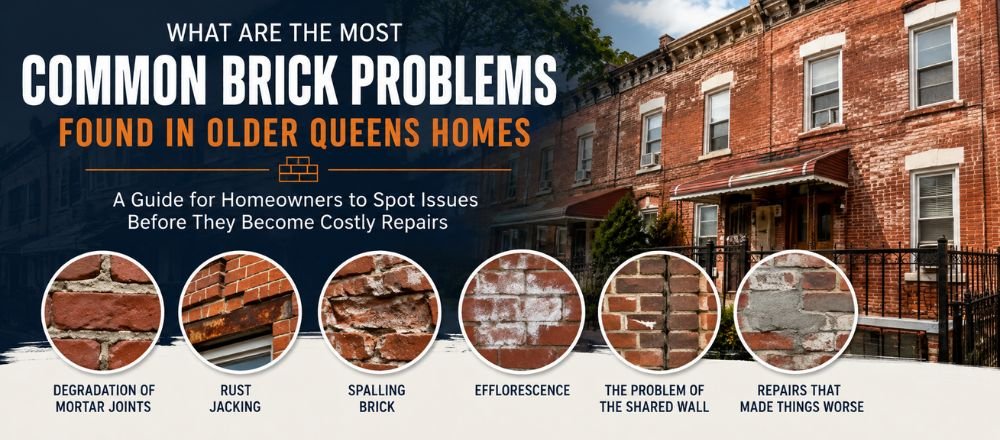
The mortar is supposed to be the sacrificial element of a brick wall. It is softer than brick, so it wears instead of brick. Expect crumbling, receding or missing mortar on century-old Queens rows, especially on north- and west-facing walls that take the brunt of the weather. Leaving the joints open allows water to run right into the wall system. This causes nearly every other problem here.
There was a time for building, and steel lintels, the horizontal bars across windows and doors, were the norm. “When that water gets behind that brick to that steel, it rusts. Rust also grows physically, pushing at the surrounding masonry. The city’s Department of Buildings’ glossary of facade terms calls this “rust jacking.” The giveaway is a stair-step pattern of cracks or a bulge of brick right above a window or door. It’s not a caulk and forget fix, it’s a structural, not cosmetic issue, to replace the lintel, you have to remove several courses of brick.
Spalling happens when the surface of the brick flakes, pops or crumbles off, usually because moisture inside the brick freezes and expands, or a modern, hard cement mortar was used to patch old, soft brick and now traps water that used to evaporate freely. It tends to accelerate once it gets going, for the exposed brick inside is more vulnerable than the surface was.
Efflorescence is the white, chalky film that appears on brick or foundation walls. It’s mineral salts deposited when water migrates through the masonry and evaporates. It’s not harmful in itself, but it’s a good early indicator that water is actively moving through the wall, and on older Queens brick it often appears long before spalling or cracking can be seen.
In Ridgewood’s brick rows and Astoria’s densely packed blocks along 30th Avenue and Ditmars Boulevard, rowhouse and semi-detached construction means that many homes share party walls and parapet walls with their neighbours. Sometimes the problem is not unique to the property with the shared wall’s lintel or mortar, and coordinating repairs and sometimes costs with a neighbour is a very Queens-specific wrinkle that detached-home guidance elsewhere leaves out.
Ironically, some of the worst damage is caused by well-meaning repairs in the past. Hard modern Portland cement mortar does not breathe like the original lime-based mortar, trapping moisture inside soft old brick, not letting it evaporate out and accelerating spalling. If a previous owner “fixed” cracked mortar with the wrong material, that patchwork could be actively damaging today.
Efflorescence and minor mortar wear are maintenance items. Structural warning signs include step cracking above windows, bulging brick or spreading spalling, all good reasons to have a mason assess the situation. For homes this old, the root cause is almost always water finding its way into brick that was never built to take modern hard-mortar patches. So the fix that really lasts begins with materials matched to the original construction, not just filling the gap.